Release Date: 2025-02-25
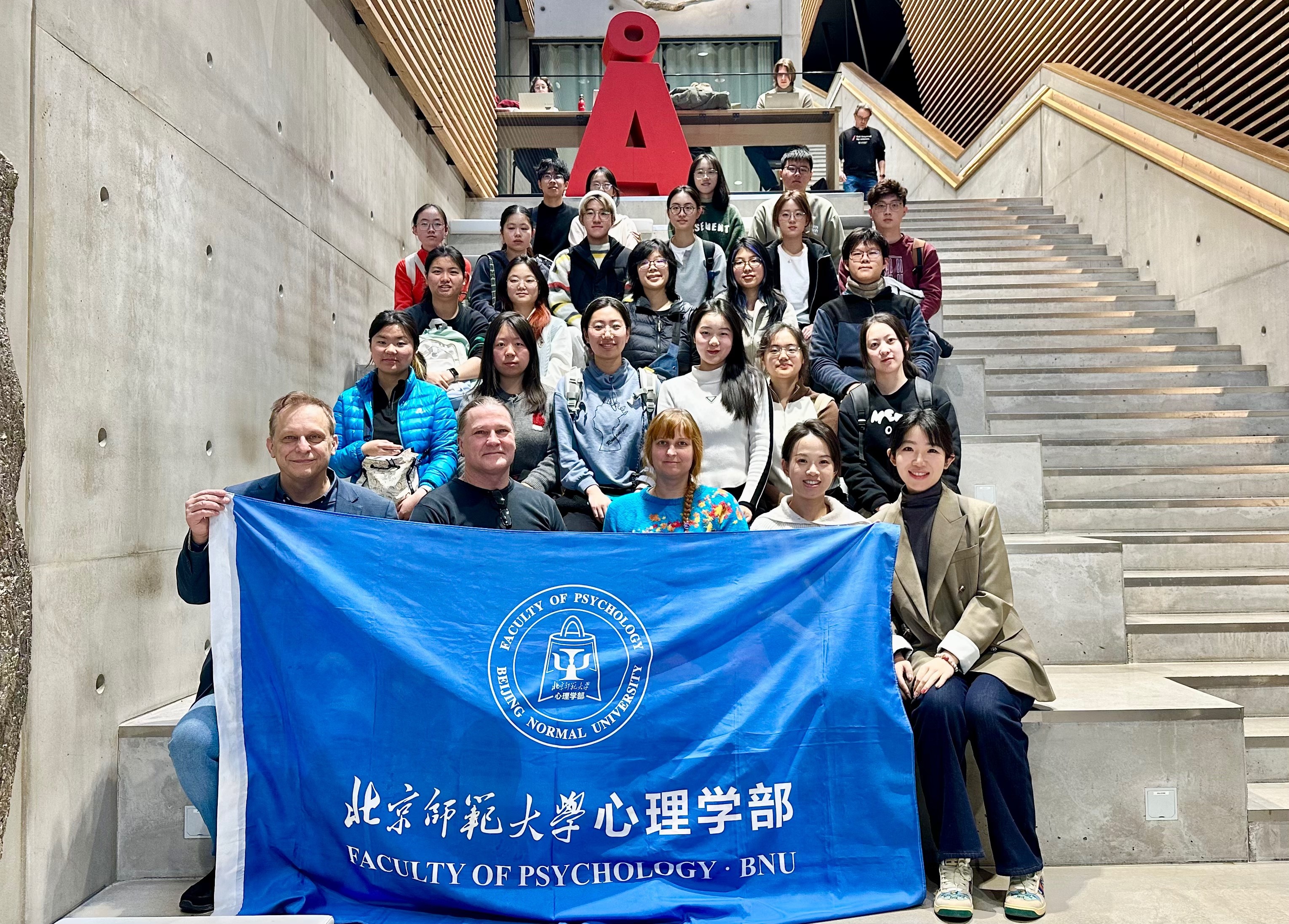
21 undergraduate students from the Faculty
of Psychology, Beijing Normal University, led by faculty members Zhang Yijing
and Xiao Xiyao, participated in the "LUMA Teacher Training Program"
winter exchange program at the University of Helsinki and the University of
Turku in Finland from February 13 to 23rd, 2025. The exchange program was
focused on innovation and practice in science education, which has involved
academic lectures, classroom observations, scientific practice, and cultural
visits to explore the Finnish education system and teacher training models in
depth.

Figure
1:Arriving at the University of Turku.
Course Learning: Integration of Theory and
Practice
The academic part of the programs has
concentrated on the intersection of psychology and science education. Oona
Kiviluoto, specialist at the LUMA Centre Finland network, systematically
introduced Finland's national strategy for science education. Dr. Lotta
Uusitalo has given a lecture entitled "Positive Pedagogy and the Use of
Strengths in Learning" using the PERMA model of positive psychology
(positive emotions, engagement, meaning, relationships, and achievement) to
explain why focusing on students' strengths can enhance teaching effectiveness.
During the course, students and teachers interacted through personality
strength cards and case studies of the "iceberg model" for goal
achievement, experiencing the learner-centered educational philosophy.

Figure
2: Lotta Uusitalo applies positive psychology to education.
The delegation paid a visit to a
comprehensive nine-year secondary school in Helsinki to observe English and
mathematics classes. Where the students could observe open discussions,
interdisciplinary task design, and teacher-guided questioning strategies
demonstrated in Finnish basic education system and emphasis the key role of
students' critical thinking.

Figure
3: Observing classes at the nine-year integrated school
Scientific Practice: From Laboratory to
Educational Frontline
At the Helsinki Science Center Heureka, students
observed over 400 interactive exhibits which has transformed principles of
physics, chemistry, and other disciplines into fun experiments. Students
intuitively understood scientific knowledge by building wind turbine models and
operating molecular structure devices. The Science Museum showcased the trajectory
of Finnish technological innovation through exhibits such as Nokia
communication devices and polar scientific research equipment.
At the University of Turku, the students
team has deeply engaged in science education practice, including:
1. Phenomenon-Based Learning Experiment guided
by Laszlo Major and Matleena Tuomisto. Students conducted the "mystery
powder identification" experiment (observing physical characteristics,
acid-base reactions, etc.) to grasp the logic of phenomenon-based teaching
design.

Figure
4: Exploring the mysterious powder.
(1) Liquid Nitrogen Superconductivity
Experiment given by Dr. Pasi Nurmi, which demonstrated low-temperature physical
phenomena such as liquid nitrogen magnetic levitation and high-speed operation
of superconducting tracks.
(3) 3D Printing Workshop given by Professor
Heidi Piili, which instructed students in operating industrial printers to
complete works such as metal Eiffel Tower models and explored the application prospects
of 3D printing of biological tissues.

Figure
5: Hands-on and computer practice in the 3D printing workshop
Interdisciplinary Integration: Psychology
and Frontier Technologies
Dr. Tuomo Häikiö from the Department of
Psychology at the University of Turku showcased the application of eye-tracking
technology in dyslexia research, which has allowed students to experience
portable eye-tracking devices firsthand. Dr. Laszlo Major has compared
artificial neural networks with human brain cognitive mechanisms, sparked the
students’ discussions on the integration of artificial intelligence and
psychology.

Figure
6: Students experience wearable eye-tracking devices.
During the academic discussion session, Dr.
Nie Peixin and Dr. Liu Xiazhen shared their research findings: Dr. Nie Peixin
verified the transfer effect of music training on language working memory
through pitch training and cross-experiments with native language backgrounds. Dr.
Liu Xiazhen designed a music intervention program for Chinese language
teaching, combining tools such as digit span tasks and pitch memory tasks to
improve the efficiency of Chinese language learning among Finnish children.
Cultural Visits: A Dialogue Between Nature
and Science
The team visited the University of Turku's
Zoological Museum (with a collection of 4 million specimens), Botanical Garden
(greenhouse conservation and digital management), and Observatory (black hole
simulation devices and lens coating technology), students have gained an
in-depth understanding of Finland's educational practice of "Transforming
Nature into Learning Spaces"

Figure
7: Visiting the botanical garden.
Future Collaboration: Looking forward to a bright future
Beijing Normal University and Finnish
universities have a solid foundation of cooperation in teacher training and
science education. This exchange, supported by the "Sino-Finnish Joint
Learning Innovation Institute (JoLii)," further promotes collaboration
between the two sides in curriculum development and educational technology
validation. In the future, the Faculty of Psychology will continue to expand
international training pathways to provide students with broader academic
platforms.